Brite Tank Brewing: How BBTs Clarify, Carbonate & Ship Better Beer
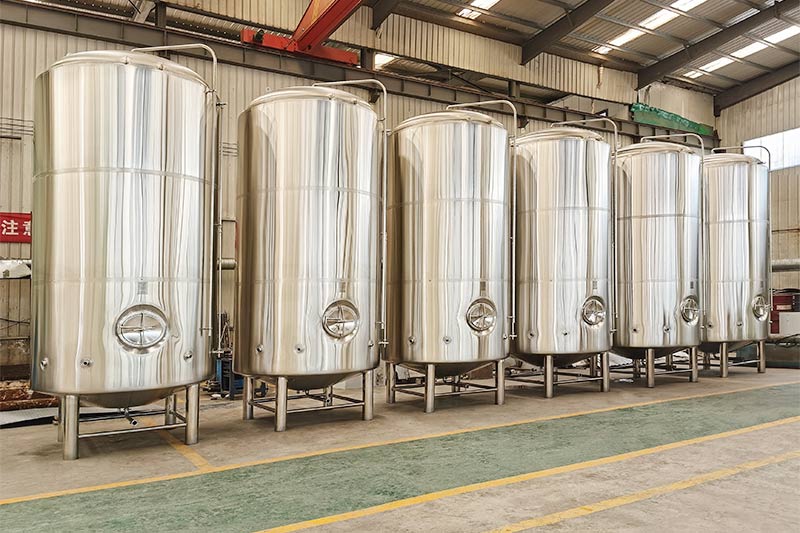
A brite tank (BBT) is the pressure-rated, temperature-controlled vessel where post-fermentation beer clarifies, carbonates to spec, and rests under a CO2 blanket until it feeds a keg, can, or bottle line. It decouples fermentation from packaging and locks in dissolved CO2 volumes with 0.03–0.05 vol precision.
What a Brite Tank Actually Does (Beyond “Storage”)
Ask five brewers what a BBT does and you’ll get five answers: some call it a serving tank, some a conditioning tank, some just “the last tank before the filler.” The vessel doing that work is the same. The operational role changes with brewery style.
The core job breaks down into four things happening in parallel:
1. Clarification. Cold temperatures (typically -1 to 2 °C) drop yeast and protein-tannin haze to the dished bottom, where a drain valve pulls them off before packaging.
2.. Carbonation adjustment. A porous carb stone diffuses CO2 into the beer at controlled pressure, bringing volumes to style spec — usually 2.2–2.7 vol for ales, 2.5–2.8 vol for lagers.
3.Maturation. A few extra days at cold temperature let residual diacetyl, acetaldehyde, and sulfur compounds reduce out.
4.Packaging buffer. The BBT holds finished beer at counterpressure so the filler can run at its own pace without waiting on the fermenter.
That last point is where nano and small commercial breweries most often trip up. Without a dedicated BBT, every packaging day ties up a fermenter, which means the next brew day slides right — and a brewery running 5 BBL batches on a two-week fermentation cycle can lose 15–20% of annual output to that scheduling drag.

The Fermenter-to-Brite Ratio Most Guides Skip
Most brite-tank explainers describe what the vessel does. Few tell you how many you need. This is where an underbought cellar starts leaking money six months in.
The working guideline that holds up across most craft breweries: BBT working volume should equal 1.0 to 1.2 times a single brewhouse turn, plus 10% headspace for foam and carbonation.
A 10 BBL brewhouse pairs cleanly with an 11–12 BBL BBT. A 20 BBL brewhouse pairs with a 22–24 BBL BBT. If you cold-crash and package the same day, one BBT per fermenter position works. If you’re batching lagers that need 3–4 weeks of lagering before packaging, plan for 1 BBT per every 3–4 fermenters, with each BBT sized to handle a double batch.
Compared to unitank-only setups, dedicated BBTs decouple fermentation from packaging. In a unitank-only cellar, packaging day means the tank is locked out from a new brew until the whole batch is drained, losing potentially a week of that fermenter’s productive time. A separate BBT gets the fermenter back in service the same day.
Here’s the sizing table most procurement conversations skip:
| Brewhouse size | Minimum BBT (single-batch) | Recommended BBT (double-batch lager) | Typical BBT-to-fermenter ratio |
| 3.5 BBL | 4 BBL | 7 BBL | 1:2 |
| 7 BBL | 8 BBL | 15 BBL | 1:3 |
| 10 BBL | 11 BBL | 20 BBL | 1:3 to 1:4 |
| 15 BBL | 17 BBL | 30 BBL | 1:3 to 1:4 |
| 20 BBL | 24 BBL | 40 BBL | 1:4 |
| 30 BBL | 35 BBL | 60 BBL | 1:4 to 1:5 |
Under-sizing a BBT (buying an 8 BBL vessel for a 10 BBL brewhouse “to save space”) forces you to split every batch or leave beer in the fermenter. Both options cost more than the tank you saved on.
Carbonation Inside the Tank: Stone, Flow, Pressure, Time
Force-carbonating in the BBT is the most common way to hit volume specs precisely. Four variables interact:
1. Stone porosity. Sintered stainless steel stones at 0.5 μm produce fine, dissolvable bubbles. Coarser stones (2 μm and up) release CO2 faster but foam harder, wasting gas and adding time.
2. CO2 flow rate. A working range is 0.5 to 1.0 liters of CO2 per minute per 10 hL of beer. On a 10 BBL (11.7 hL) tank, that means starting around 0.6 L/min and adjusting up. Push too much gas and you’ll foam over the PRV; too little and you’ll wait 48+ hours to hit target.
3. Head pressure and temperature. These pair together, per Henry’s law. Typical set-points:
- Lagers: 12–18 psi (0.8–1.2 bar) at 0–2 °C, targeting 2.5–2.8 vol
- Ales: 10–15 psi (0.7–1.0 bar) at 2–4 °C, targeting 2.2–2.5 vol
- Hazy IPA and pastry stouts: 10–13 psi at 0–2 °C, targeting 2.3–2.6 vol
4. Time. Even at correct pressure and flow, most force-carbonation runs need 12 to 48 hours before the beer stabilizes. Rushing it produces a batch that reads “close enough” at the sample port and gushes at the filler.
Verify with an inline CO2 meter before the transfer. A calibrated meter costs less than one pallet of returned gushing cans.
Dissolved Oxygen: The Number That Silently Kills Your Shelf Life
Every brewer talks about clarity and carbonation. Fewer talk about DO — dissolved oxygen — even though it’s the single biggest lever on shelf-life stability.
Target DO numbers a well-run BBT should hit:
- Post-transfer into BBT: below 20 ppb
- Post-carbonation, pre-transfer to filler: below 30 ppb
- In package: below 50 ppb total package oxygen (TPO)
Anything above these numbers and you’re shipping beer that will oxidize, brown, and taste stale within 6–8 weeks instead of 20+.
The BBT itself contributes to DO control in several ways. A CO2 pre-purge before beer transfer (fill and vent the tank two or three times with CO2 to displace air) knocks resident oxygen down to less than 5 ppm before beer even arrives. Positive CO2 counterpressure during transfer from the fermenter prevents air suck-back through the transfer line. Proper spunding valve or PRV setup blocks air ingress during sampling. And routine draining of residual CIP water from racking arms and sample lines closes the last common leak point.
One edge case that catches new breweries: CIP water left in the racking arm. If the arm isn’t fully drained after cleaning, transferred beer picks up dissolved oxygen from the trapped water. A quick CO2 blow-through before beer transfer solves it. Most owners find this out the hard way when a batch tastes fine on release day and cardboard-flat by week four.
From BBT to Packaging: Keg, Can, and Bottle Feed
The BBT is designed to feed the packaging line at controlled pressure. Three common configurations show up in most craft cellars.
Keg filling. Direct feed with CO2 counterpressure. Kegs pre-purged with CO2 or steam. Flow rate typically 15–30 seconds per half-barrel keg on isobaric fillers.
Can filling. Cans need lower shear and tighter DO control than kegs. A 12-head isobaric can filler running at 1,000–1,200 cans per hour draws from BBT counterpressure at 12–15 psi, with the can headspace CO2-purged before seaming. This is the configuration used in Micet Craft’s fully automated can filling lines, spec’d at ≤4 °C filling temperature and ±5 mm filling accuracy.
Bottle filling. Similar isobaric principle. On an 8-head bottle filler running at 480–500 bottles per hour for 275 ml or 750 ml formats, the BBT supplies pressurized beer through a CO2 mixer if inline carbonation adjustment is needed.
For any of these, the BBT’s outlet valve should sit low enough on the dished bottom to draw beer without pulling headspace, but high enough to leave the trub layer behind. A 5° dish angle handles this reliably.
Micet Craft Brite Beer Tank Specifications
Micet Craft’s BBT product line spans 1 BBL to 300 BBL, with the most commonly ordered vertical sizes at 10, 15, 20, 25, 30, 35, 40, 50, and 60 BBL. A 3000L horizontal bright tank option is available for cellars that need lower ceiling clearance or higher floor stability.
Standard construction and configuration:
- Shell material: food-grade 304 or 316 stainless steel (316 recommended for higher-chloride water sources or sour beer programs)
- Internal finish: mirror polish to Ra ≤ 0.6 μm, sanitary weld standard
- Jacket: dimpled glycol jacket, sized to hit cold-crash target within 24 hours
- Pressure rating: standard 15 psi working / 30 psi test, upgradeable to 30 psi working for higher-carb styles
- Bottom: 5° dished with sanitary drain valve
- Fittings: sample port, sight glass, PRV, vacuum relief, CIP spray ball, carb stone port, racking arm
- Insulation: 80–100 mm polyurethane foam, 2B stainless cladding
Micet Craft’s pressure vessels — including BBT lines — are covered under third-party PED verification. The Verification of Conformity issued by ICR Co., Ltd. (certificate ICR/VC/HM2507146, valid to July 2030) covers Brewery Equipment, Fermentation Equipment, and Pressure Vessel scope under EU Directive 2014/68/EU and standards EN 1626:2008 and EN 10204:2004. For breweries selling into EU markets, this documentation is what a customs broker or on-site inspector will ask for.
Pricing: because BBT specification depends on capacity, pressure rating, jacket configuration, and fittings package, Micet Craft does not publish a standard list price for the BBT range. Quotes are configured against each brewery’s brewhouse size, cellar layout, and packaging line, and are provided within 48 hours of a specification request.
Common Mistakes That Cost Breweries Money
Four operational patterns show up repeatedly in cellar-audit conversations. Each looks minor. Each ships bad beer.
Skipping the CO2 pre-purge. Transferring beer into a BBT still holding atmospheric air adds 200–400 ppb DO to the batch instantly. That number does not come back down. Purge twice with CO2 before every beer transfer.
Running the carb stone too hard. Cranking the CO2 to shorten carbonation time turns fine bubbles into foam that vents out the PRV. You lose gas, waste money, and end up under-carbed anyway.
Under-sizing to save floor space. An 8 BBL BBT paired to a 10 BBL brewhouse forces you to split every batch. This shows up first as a scheduling problem, then as a payroll problem, then as a “why are we losing money” problem.
Cleaning shortcuts on the racking arm and carb stone. Both are dead-leg-prone. A carb stone that isn’t reverse-flushed weekly develops biofilm, and a biofilm-loaded stone drops CO2 diffusion efficiency by roughly half. The brewer then compensates with higher pressure, feeding the loop.
Compared to unitank-only cellars that leave carbonation to spunding valves and open-vent fermentation, a properly operated BBT gives you numbers you can hit and repeat. That repeatability is what turns packaged beer into a business rather than a hobby.
FAQ
Q: Do I really need a dedicated brite tank, or can I just use a unitank?
A: A unitank can carbonate and package, but it locks up the fermenter and makes DO control harder. If you package more than one batch per week, or if you sell in cans and bottles rather than just draft, a dedicated BBT usually pays back inside 12 months through faster fermenter turnover.
Q: What’s the ideal fermenter-to-BBT ratio?
A: Rule of thumb is 1:3 to 1:4 for ale-focused breweries. For lager-heavy programs with 3–4 week conditioning, closer to 1:2. Size each BBT at 1.0–1.2× a single brewhouse turn.
Q: How long does force carbonation actually take in a BBT?
A: 12 to 48 hours, depending on stone porosity, CO2 flow, beer temperature, and target volumes. A 10 BBL lager at 0.6 L/min through a 0.5 μm stone at 15 psi and 0 °C typically hits 2.6 vol in about 24 hours.
Q: Can a brite tank be used for cider, kombucha, or hard seltzer?
A: Yes. The same clarify-carbonate-hold logic applies. For sour-adjacent products, 316 stainless is preferred over 304 to handle lower pH and chlorides. Micet Craft’s BBT range covers beer as well as cider and kombucha applications.
Q: What’s the difference between a horizontal and vertical brite tank?
A: Vertical tanks (the standard) fit smaller floor footprints and are easier to CIP. Horizontal tanks (like the 3000L horizontal option) work better for cellars with height restrictions or for direct-serve applications where a wider surface area helps clarity settle faster.
Q: Do brite tanks need CE or PED certification for import to Europe?
A: Yes. Any pressurized vessel above certain volume-pressure product thresholds requires PED (Pressure Equipment Directive 2014/68/EU) documentation for import into the EU. Micet Craft’s BBT range is covered under third-party PED verification through ICR Co., Ltd.
Q: How much floor space does a BBT need?
A: A 10 BBL vertical BBT typically has a 1.2 m outer diameter and 3.0 m overall height. Plan for a 1.5 m diameter footprint plus service clearance around the tank. A 30 BBL vertical unit runs closer to 1.8 m diameter and 4.2 m tall.